
Handmade Ceramic Fountains vs Resin Fountains: What’s the Difference?
When shopping for an indoor fountain, many people are surprised to discover that products that appear similar in photographs can be made from entirely different materials and manufacturing processes.
Two of the most common categories are molded resin fountains and handmade ceramic fountains. While both circulate water and can be attractive additions to a living space, they differ significantly in how they are made, how they age, and the experiences they offer their owners and others who see them.
How Resin Fountains Are Made
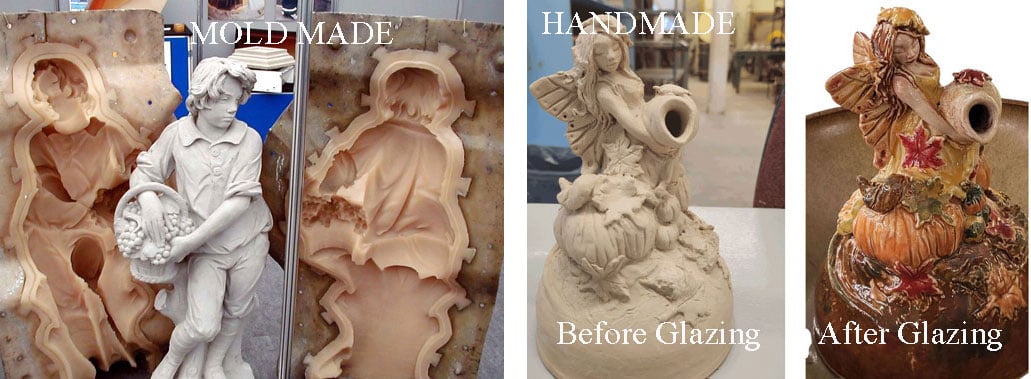
Most resin fountains begin with a model, used to create a mold. The model is created using any of a variety of techniques, such as laser cutting via a computer program, to generate a master copy of the desired item This makes it possible to include a great deal of detail.
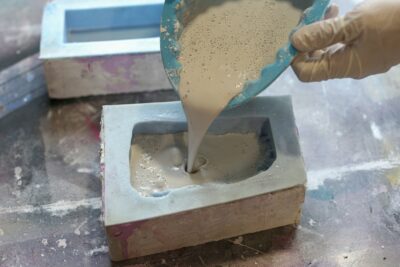
The model is placed into a leak-proof box and liquid resin is poured around it and allowed to cure. When cured, it is removed, painted and if more than one piece, it is assembled.
Because the mold can be used repeatedly, hundreds or even thousands of identical fountains can be produced. This manufacturing process makes resin fountains widely available and very much less expensive than handmade work. Their lightweight construction also reduces shipping costs and makes them easy to move. For buyers seeking a decorative water feature at a modest price point, molded resin can be an appealing option.
How Handmade Ceramic Fountains are created


Handmade is a very different process, relying on the tools, skills and techniques employed for many thousands of years to form the piece. Once the piece is made the modern technology of the kiln comes into play.
Each work begins as raw clay which is formed by the hands of the artist. It is often carved or tooled in any of a number of ways with a variety of relatively simple tools. Once it is completely formed and refined it is allowed to dry thoroughly under wraps to prevent cracking. Once dried it is fired in a kiln to about 1900 ° F which removes all the moisture from the piece. It is then coated (painted, dipped or sprayed), with glazes specifically formulated to give specific qualities, such as color, gloss and other internal and external attributes. It is fired again to about 2300° F during which process the glaze, which has penetrated the clay, becomes a hard, durable glass.
Although a ‘theme’ might be reproduced; the artist may make more than one Octopus sculpture, for example, they will never be the same. Not only is it nearly impossible to exactly recreate a handmade piece, it is almost never desirable to the artist. That’s why they are artists – they enjoy creating.
The result is, in the case of Beautiful Fountains, not just an indoor fountain but a work of ceramic sculptural art with flowing water.
Appearance & Surface Quality
Resin fountains normally rely on paint to imitate a material such as stone, metal, wood, ceramics or some other natral material, and they are sometimes fairly convincing, especially when viewed from a distance.
The image to the right is one such piece and the seller graciously informs us that the piece will need repainting after a time, particularly where the water flows. How easy or difficult that will be, to match the colors and get it right is difficult to say.

With Ceramics The Color is Part Of the piece
With ceramic fountains the color is as much a part of the piece as is the form – it can’t be separated from it, washed off or faded with time and light. The color is fused in and is integral to the piece.
The glazes are formulated for high-firing, durability and the degree of gloss is also regulated, some formulated for a matt or semi-matt surface, some for high gloss. Glazes receive and respond to light differently from painted surfaces, creating depth, variation and richness in a way and to a degree that paint simply cannot.

Durability Over Time
Both materials can provide years of enjoymenht when properly maintained, but they do age differently. Resin may become scratched, faded or chipped after extended exposure to sunlight or handling. Because the finish is often applied to the surface, this may reveal the material beneath, thus destroying the illusion.
High fire ceramics is extremely durable and because the glaze is part of the material, not a coating, it will last unfaded essentially forever. Ceramics, like resin objects, can be broken, so reasonable care is required for both.
Weight & Stability
One advantage of resin is its light weight. This makes resin fountains cheaper to ship and easier to reposition. Ceramic fountains are generally heavier. While this increases shipping costs, the weight often provides greater stability and a more substantial presence in a room. Many owners appreciate the feeling that a handmade ceramic fountains has permanence rather than a temporary quality often associated with lightweight decor.
Uniqueness
Perhaps the greatest difference between ceramic handmade and resin mold made fountains lies in uniqueness.
A resin fountain is designed to be exactly identical to every other fountain produced from that mold, of which there may be hundreds or thousands.
A handmade sculpture fountain is not. Each fountain is unique. Even when an artist creates within a theme, each piece reflects individual decisions made during the creation. The particular attitude of the piece: A fox may be sitting on a log, lying by a brook, be accompanied by other creatures or a solitary figure.
Decisions made during the sculpting – the textural options, details of the pose and many other sculpting, glazing and finishing options come into play, all working together to bring to life a one of a kind work.
For collectors, homeowners and interior designers seeking distincive pieces, this individuality is often one of the most valuable qualities a handmade fountain can offer.
Art Versus Decoration
Neither material is inherently right or wrong. It depends entirely on what you want. If your primary goal is an affordable decorative accent, a resin fountain may be the best practical solution. If you want a one-of-a-kind piece created by an artist, built to become part of your home’s character for many years, a handmade ceramic sculpture fountain will give you something special that only you will have. And if you choose sometimes to not have it as a fountain you will continue to have a ceramic sculpture, waiting to be enlivened by the flick of a switch.
Art & Creativity is what Beautiful Fountains is all about. It is what we do. Fountains are wonderful and we feel an indoor fountain should be more than a decorative object but an almost living piece of ceramic sculptural art that also provides the enjoyments and benefits of moving water.