

Why Handmade Ceramic Objects Feel Different
There’s a gentle transformation that happens when a handmade ceramic object becomes part of a room. It’s not dramatic, but over time it becomes one of the things your eye returns to. It makes you happy somehow, without quite knowing why. Or perhaps you do.
We tend to think of objects in terms of function or style—what they do, or how they fit into a look. Handmade ceramics operate both inside, and a little outside of both categories. They carry something less definable, but very evident.
Part of it begins with irregularity.
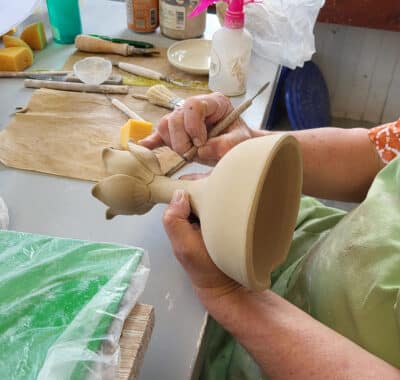
No Handmade ceramic piece is perfect
and it shouldn’t be. The rim might be a fraction thicker in one place, each petal of a flower will have slight variations, as in nature. The surface might undulate slightly under the glaze and the glaze will often not present a perfect pattern you can mathematically measure. Your eye and hand and emotional perception register these differences almost subconsciously.
These are not flaws. This is true Wabi Sabi. In a room full of precise lines and manufactured finishes, that subtle variation creates a kind of visual pause and a refreshing sense and realization of the lack of mass production. It is the difference between something sterile and something living – something machine-made and something formed by the hands of a living person. That difference is enormous.
There’s also a difference in how handmade ceramics hold light.
Industrial surfaces tend to reflect light uniformly. Handmade glazes, especially those fired in small collections, often absorb and scatter light in more complex ways. A matte or semi-matte glaze softens brightness. A glossy one might pool more deeply in certain areas, creating variation in tone. As the light in a room changes throughout the day, the object changes with it—quietly, but continuously.
Then there’s weight.
Not just physical weight, though that matters too—but a sense of groundedness. Handmade ceramics often feel more anchored. The density of the material, the thickness of the walls, the balance of the form—all contribute to an object that seems to become part of a space rather than just occupy it. Like something not made simply to be bought but something created for its beauty to be properly placed and enjoyed.
You can notice this most when you move one. It doesn’t feel disposable or interchangeable. It asks to be handled with a bit more attention.
Another layer is time.
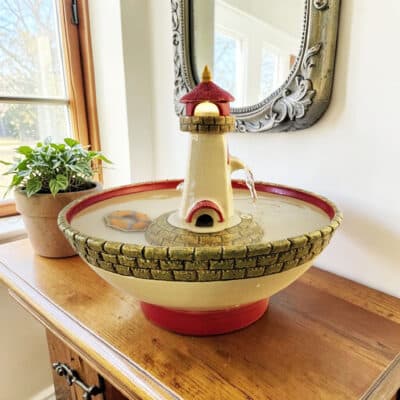
A handmade ceramic object carries within it the process of its making: The shaping, the glazing, the drying, the firing, the cooling. None of this is rushed. Even if you don’t think about these steps consciously, there’s a kind of stillness in the finished piece that reflects them. It doesn’t feel instantaneous. Because it is in fact, far from that. It is a consequence of a sequence of processess each of which is indespensible and which need to be executed with skill and artistry.